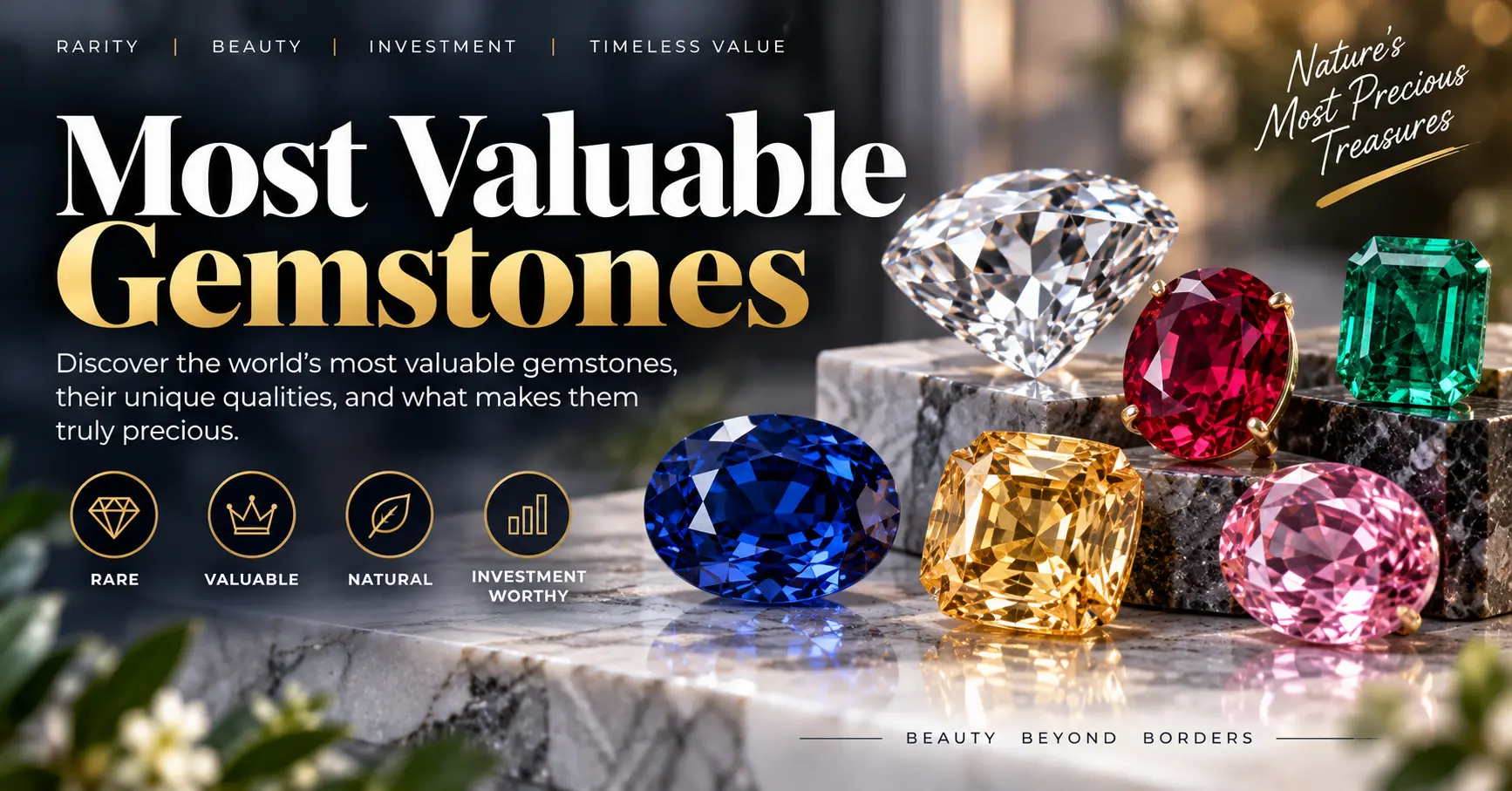

Most valuable gemstones are prized for a combination of rarity, beauty, durability, provenance, size, and exceptional quality. While diamonds, rubies, sapphires, and emeralds dominate the traditional precious gemstone market, rare stones such as alexandrite, Paraíba tourmaline, red beryl, and fine jadeite can also command extraordinary prices.
For buyers in India, understanding gemstone value is particularly important because the market includes everything from investment-grade natural gems and traditional jewellery stones to treated, synthetic, and imitation materials.
This guide explains which gemstones are considered especially valuable, why certain stones cost more than others, how gemstone quality is assessed, and what you should check before buying an expensive gem.
What Makes a Gemstone Valuable?
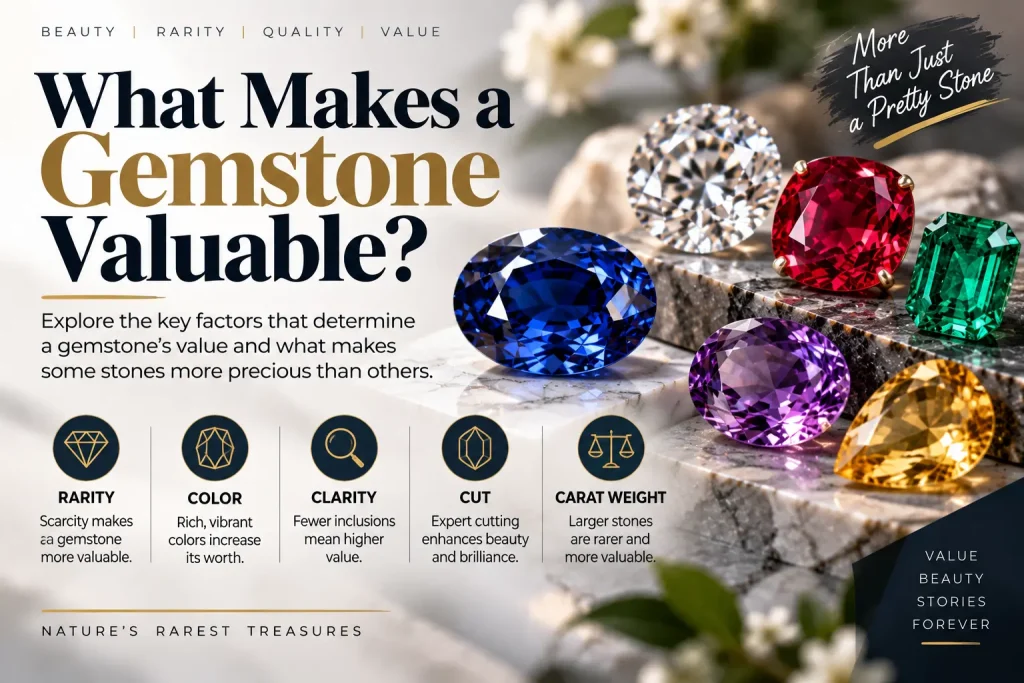
A gemstone becomes valuable when desirable qualities are combined with limited supply and strong demand. Rarity alone does not automatically make a mineral expensive. The stone must generally have characteristics buyers actually value, such as attractive colour, clarity, durability, or cultural importance.
Several factors influence gemstone value.
Rarity
Natural scarcity can significantly increase value. Some gemstone materials occur only in limited geological environments or are found in relatively few commercially important deposits.
However, rare does not always mean expensive. A very rare mineral with little jewellery demand may be worth less than a high-quality ruby or sapphire with an established global market.
Colour
Colour is one of the most important factors for many coloured gemstones. Buyers generally examine hue, tone, saturation, colour distribution, and overall visual appeal.
For example, two rubies of the same carat weight can have dramatically different values because their colours differ in intensity and quality.
Clarity
Clarity refers to inclusions and other internal characteristics visible within a gemstone. The importance of clarity depends on the gem variety.
Some inclusions reduce beauty and durability, while others are normal for a particular stone. Emeralds, for example, commonly contain visible inclusions, so they should not be judged according to exactly the same clarity expectations as diamonds.
Carat Weight
Larger high-quality natural gemstones are generally harder to find than smaller examples. As a result, price per carat can rise considerably as size increases.
Carat weight alone, however, does not determine value. A smaller gem with exceptional colour and clarity can be more desirable than a much larger stone of poor quality.
Cut
A skilled cut can improve brilliance, colour appearance, proportions, and overall attractiveness. Poor cutting can make an otherwise excellent gemstone appear dull, overly dark, or visually unbalanced.
Origin and Provenance
Geographic origin can sometimes influence market desirability, particularly for certain rubies, sapphires, emeralds, and other collector-grade gems.
Origin should be established through reliable gemological testing when it materially affects a purchase. Seller claims alone should not be treated as proof.
Treatments
Heating and other treatments are common within parts of the gemstone industry. Treatment does not automatically mean a gemstone is undesirable, but disclosure is important.
Untreated stones of exceptional quality can sometimes receive substantial premiums because they are considerably rarer.
Which Are the Most Valuable Gemstones?
There is no permanent ranking of the most valuable gemstones because prices vary according to individual quality, size, treatment, provenance, certification, market conditions, and buyer demand.
However, the following gemstone varieties are regularly associated with the high-value segment of the international gem and jewellery market.
| Gemstone | Why It Can Be Valuable | Important Quality Factors |
|---|---|---|
| Ruby | Rare fine colour and strong demand | Colour, origin, treatment, clarity |
| Diamond | Established global market and exceptional specimens | Cut, colour, clarity, carat |
| Emerald | Highly desirable green colour | Colour, clarity, treatment, origin |
| Sapphire | Durable and available in rare premium colours | Colour, treatment, origin, clarity |
| Alexandrite | Rare colour-change phenomenon | Colour change, size, clarity |
| Jadeite | Fine material can be exceptionally scarce | Colour, translucency, texture |
| Paraíba Tourmaline | Distinctive vivid blue-green colours | Colour, origin, clarity, size |
| Red Beryl | Extremely limited gem-quality material | Colour, size, clarity |
| Spinel | Fine red, pink and other colours attract collectors | Colour, clarity, size, origin |
1. Ruby
Ruby is one of the world’s best-known precious gemstones and is the red variety of the mineral corundum. Fine natural rubies can be exceptionally valuable when they combine attractive colour, transparency, size, and desirable gemological characteristics.
Colour is particularly important. Strong, vivid red stones generally receive more attention than gems that appear overly dark, pale, brownish, or strongly purplish.
What Makes Ruby Valuable?
The main considerations include:
- Attractive and evenly distributed red colour
- Good transparency
- Larger carat weight
- Quality of cut
- Treatment status
- Verified geographic origin when relevant
- Independent laboratory documentation
Heating is widely encountered in the ruby trade. Buyers considering a particularly expensive unheated ruby should obtain a respected laboratory report confirming its characteristics.
2. Diamond
Diamonds remain among the most commercially important valuable gemstones. Their combination of exceptional hardness, brilliance, established grading standards, and worldwide jewellery demand gives them a unique market position.
A diamond’s quality is traditionally assessed through the 4Cs: cut, colour, clarity, and carat weight.
Colourless diamonds and fancy-colour diamonds should be considered separately. Rare natural fancy colours, including certain pink, blue, red, and green diamonds, can occupy a very different market from conventional colourless stones.
Why Are Some Diamonds Extremely Expensive?
Exceptional diamonds combine characteristics that are difficult to find together. A large stone with desirable colour, high clarity, an excellent cut, and documented natural origin will generally be much rarer than an ordinary commercial diamond.
Natural and laboratory-grown diamonds should also be clearly distinguished when comparing value.
3. Emerald
Emerald is the green variety of beryl and has been treasured for centuries. The finest examples display an attractive green colour combined with enough transparency to create a lively appearance.
Unlike diamonds, emeralds commonly contain inclusions. Buyers therefore need realistic clarity expectations.
What Determines Emerald Value?
Colour is usually a major consideration, followed by transparency, clarity, size, cut, treatment, and sometimes origin.
Many emeralds are treated with oils or other substances to reduce the visibility of surface-reaching fractures. The nature and extent of treatment should be disclosed when purchasing a valuable stone.
4. Blue Sapphire
Blue sapphire is another variety of corundum and is closely related to ruby. Its excellent durability makes it particularly suitable for rings and jewellery intended for regular wear.
The finest blue sapphires combine an appealing blue colour with good transparency and an attractive cut.
Certain geographic origins can attract market premiums, but origin should never replace an assessment of the stone’s actual quality.
Sapphire Buying Tip
Do not purchase an expensive sapphire simply because a seller associates it with a famous mining region. Ask for an independent gemological report if origin or treatment status significantly affects the price.
5. Alexandrite
Alexandrite is a rare variety of chrysoberyl famous for its colour-change effect. Fine stones can show noticeably different colours under different lighting conditions.
High-quality alexandrite is difficult to find, particularly in larger sizes with strong colour change and good clarity.
The strength and attractiveness of the colour change are major factors in determining desirability.
6. Jadeite
Jadeite is different from nephrite, although both materials are commonly referred to as jade. Exceptional jadeite can occupy the highest end of the jade market.
Fine green jadeite is especially famous, but value depends on more than colour alone.
Important Jadeite Quality Factors
Buyers examine colour, translucency, texture, uniformity, craftsmanship, and treatment.
Because treatments can significantly alter appearance and market value, laboratory testing is particularly useful for expensive jadeite purchases.
7. Paraíba Tourmaline
Paraíba tourmaline is famous for intensely saturated blue, green, and blue-green colours associated with copper-bearing tourmaline.
Its striking appearance and relatively limited supply have made fine examples highly desirable among collectors and luxury jewellery buyers.
Colour can have a major influence on value, while size, clarity, cut, origin, and treatment should also be considered.
8. Red Beryl
Red beryl is a rare red member of the beryl mineral family. Gem-quality material is uncommon, and larger attractive stones are particularly difficult to obtain.
Its rarity makes it interesting to serious gemstone collectors, although its market is much smaller than those of diamonds, rubies, emeralds, or sapphires.
Collectors should pay close attention to authenticity, clarity, colour, size, and documentation.
9. Fine Spinel
Spinel was historically confused with ruby because high-quality red spinel can have a remarkably rich appearance.
Modern gemology recognizes spinel as a separate mineral species, and fine natural specimens have developed a strong collector market.
Red, vivid pink, and certain other attractive colours can be particularly desirable. Colour, clarity, carat weight, cut, and origin can all influence value.
Are Rare Gemstones Always the Most Expensive?
No. Rare gemstones are not automatically the most valuable gemstones.
Market value requires both scarcity and demand. Some minerals are extraordinarily rare but have limited consumer recognition, jewellery suitability, or collector demand.
By contrast, ruby, sapphire, emerald, and diamond benefit from mature international markets and widespread consumer recognition.
This distinction is important when buying gemstones as collectibles or potential stores of value. Geological rarity should never be treated as a guarantee of future resale demand.
Precious vs Semi-Precious Gemstones
The traditional term precious gemstones usually refers to diamond, ruby, sapphire, and emerald.
Most other gemstones have historically been described as semi-precious.
However, this classification can be misleading when discussing actual value. An exceptional example of a gemstone traditionally labelled “semi-precious” can be rarer and more expensive than a lower-quality example of a traditional precious stone.
Modern buyers should therefore concentrate on the individual gemstone’s quality rather than its broad marketing category.
Natural vs Synthetic Gemstones
A natural gemstone forms through geological processes, while a synthetic or laboratory-created gemstone is manufactured under controlled conditions.
A laboratory-created ruby, sapphire, emerald, or diamond can have essentially the same fundamental mineral or chemical characteristics as its natural counterpart while having a very different origin and market value.
Synthetic does not mean the same thing as imitation.
An imitation merely resembles another gemstone. Glass, for example, can be manufactured to resemble a valuable coloured gem without being that mineral.
Clear disclosure is therefore essential.
Gemstone Treatments and Their Effect on Value
Treatments can improve colour or clarity, but their effect on price depends on the gemstone and type of treatment.
Common examples encountered in the gemstone trade include heating, fracture filling, oiling, irradiation, diffusion, and other enhancement processes.
Some treatments are widely accepted when properly disclosed. Others may significantly affect desirability, durability, or market value.
Before purchasing an expensive stone, ask:
- Is the gemstone natural or laboratory-created?
- Has it received any treatment?
- Is the treatment permanent or does it require special care?
- Is there an independent laboratory report?
- Does the report match the stone being sold?
How to Buy Valuable Gemstones in India
India has a long-established gem and jewellery industry, with major trading and manufacturing activity in centres such as Jaipur, Surat, and Mumbai. Buyers nevertheless need to apply the same careful verification standards they would use in any major gemstone market.
Step 1: Decide Why You Are Buying
First determine whether you want jewellery, a collector gemstone, an astrological stone, or a high-value natural gem.
Your purpose influences which characteristics matter most.
Step 2: Set a Realistic Budget
Do not judge a gemstone simply by size. Quality, rarity, treatment, certification, and colour can matter substantially more than carat weight alone.
Step 3: Request Proper Disclosure
Ask the seller whether the gemstone is natural, synthetic, treated, or untreated.
Important claims should be written on the invoice rather than communicated only verbally.
Step 4: Check Laboratory Documentation
For a high-value purchase, consider an independent report from a reputable gemological laboratory.
Read exactly what the report states. A gem identification report is not necessarily the same thing as a monetary appraisal.
Step 5: Compare Similar Stones
Compare stones with broadly similar characteristics instead of comparing only price per carat.
Two three-carat rubies, for example, may differ enormously in colour, treatment, clarity, origin, and overall quality.
Step 6: Understand the Return Policy
Check the seller’s return, exchange, and buyback terms before payment. Keep the invoice, laboratory report, photographs, and other documentation safely.
Common Mistakes When Buying Valuable Gemstones
One common mistake is assuming that the biggest stone is automatically the best. Size matters, but quality often matters more.
Another is relying entirely on a seller’s description without independent verification.
Buyers should also avoid assuming that every untreated stone is superior to every treated stone. A poorly coloured untreated gem may be less attractive and less valuable than a beautiful stone that received an accepted and properly disclosed treatment.
Other mistakes include confusing synthetic gemstones with natural stones, paying a premium for an unverified origin, ignoring durability, and buying solely because someone promises future investment returns.
Can Gemstones Be a Good Investment?
Gemstones can preserve substantial value in certain circumstances, but they should not be treated as guaranteed investments.
The gemstone market is less standardized and less liquid than many conventional financial markets. Selling a gemstone quickly at the price originally paid may be difficult.
Exceptional natural stones with strong documentation, rarity, provenance, and established collector demand may behave differently from ordinary commercial jewellery gems.
Anyone purchasing primarily for investment purposes should understand dealer margins, auction costs, authentication requirements, insurance, storage, and resale options before committing significant money.
How Should Valuable Gemstones Be Stored?
Valuable gemstones should be stored individually where possible to prevent harder stones from scratching softer materials.
Diamond is extremely hard and can scratch many other gemstones, so diamond jewellery should not be stored loosely against coloured gems.
Emeralds and some treated gemstones may require additional care. Avoid exposing valuable jewellery to harsh chemicals, extreme heat, or inappropriate ultrasonic cleaning unless you know the gemstone and treatment are suitable for that cleaning method.
For particularly valuable pieces, keep laboratory reports, invoices, photographs, and insurance documentation separately and securely.
Frequently Asked Questions
What are the most valuable gemstones?
The most valuable gemstones can include exceptional rubies, diamonds, emeralds, sapphires, jadeite, alexandrite, Paraíba tourmaline, red beryl, and fine spinel. There is no fixed ranking because an individual gemstone’s value depends on colour, clarity, carat weight, rarity, cut, treatment, provenance, documentation, and current market demand.
Which gemstone is the most expensive?
There is no single gemstone that is always the world’s most expensive. Record prices depend on individual specimens and can change when exceptional gems are sold. Rare diamonds, fine rubies, jadeite, sapphires, and other collector-grade gemstones can all reach very high values depending on their individual characteristics and market circumstances.
Are rubies more valuable than diamonds?
Some exceptional natural rubies can be worth more per carat than many diamonds, while exceptional diamonds can be worth more than many rubies. Comparing only gemstone names is therefore misleading. Size, colour, clarity, treatment, rarity, cut, provenance, and certification should all be considered when comparing individual stones.
How can I check whether an expensive gemstone is genuine?
Start with an independent gemological laboratory report, especially for a high-value purchase. Confirm that the report details correspond to the actual gemstone. Ask whether it is natural or laboratory-created and whether treatments have been detected. For an expensive purchase, avoid relying solely on appearance, online photographs, verbal assurances, or home testing methods.
Which valuable gemstone is best for jewellery?
Diamond, ruby, and sapphire are popular choices for frequently worn jewellery because they offer strong durability. Other gemstones can also make excellent jewellery but may need more careful handling. The best choice depends on the type of jewellery, frequency of wear, budget, colour preference, treatment status, and the gemstone’s resistance to scratching and damage.
Conclusion
The most valuable gemstones are valuable because they combine desirable beauty with rarity, quality, demand, and, in many cases, exceptional natural characteristics. Ruby, diamond, emerald, sapphire, alexandrite, jadeite, Paraíba tourmaline, red beryl, and fine spinel are important examples, but gemstone name alone never determines price.
For buyers in India, the safest approach is to compare quality rather than size alone, request full treatment disclosure, verify important claims through reputable gemological testing, and keep all purchase documentation.
Before buying a high-value gemstone, decide exactly what you want, establish your budget, compare several similar stones, and understand what makes the particular specimen valuable. A careful purchase based on documented characteristics is far more reliable than choosing a gemstone because of rarity claims or marketing language alone.