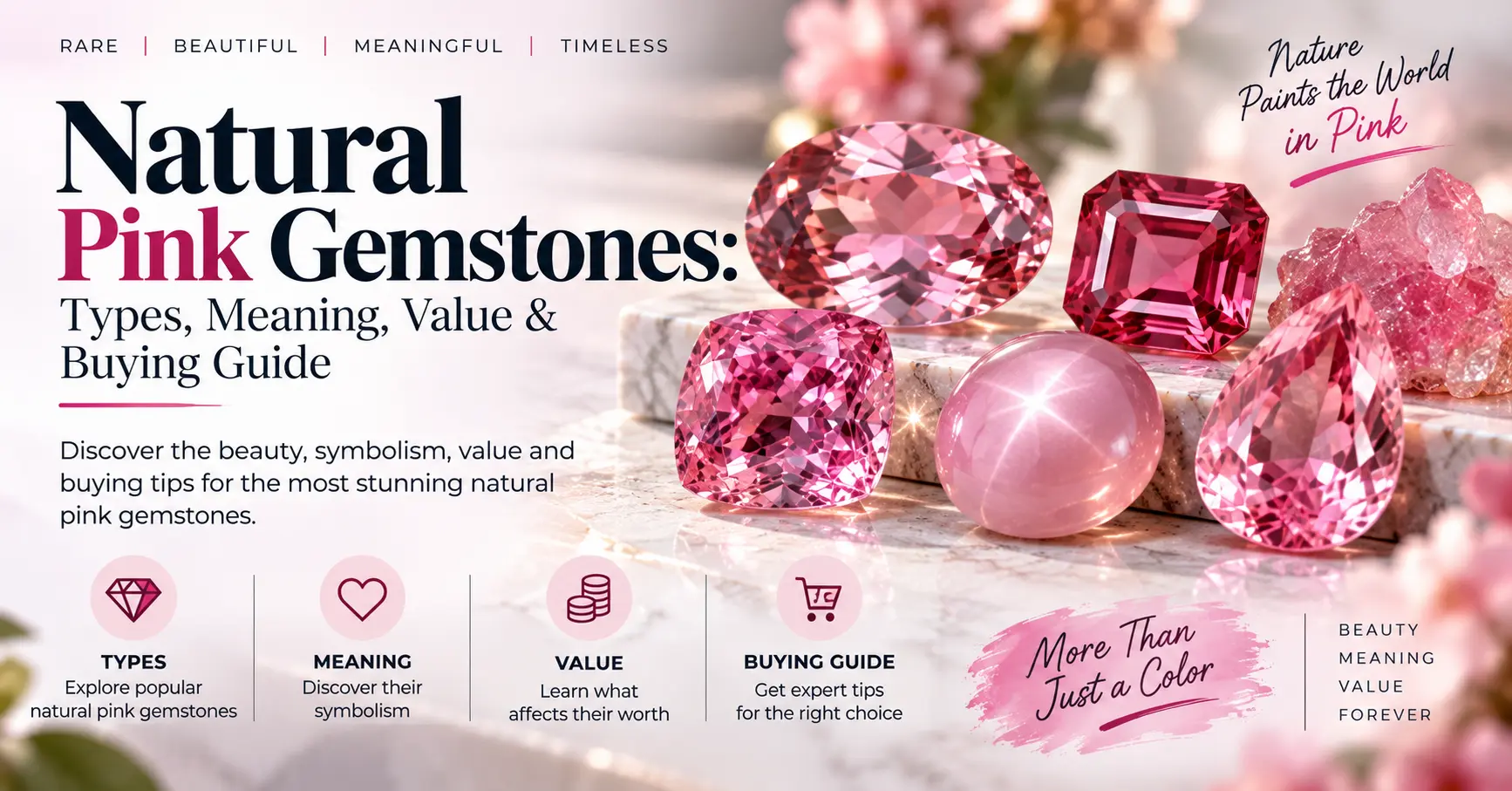

Natural pink gemstones are naturally occurring minerals and gem materials valued for their beautiful shades ranging from delicate blush and rose to vivid magenta and reddish pink. Popular examples include pink sapphire, morganite, rose quartz, pink tourmaline, kunzite, and exceptionally rare pink diamonds.
For buyers in India, pink gemstones are increasingly considered for rings, pendants, earrings, bracelets, and custom jewellery. However, appearance alone should not determine which stone you buy. Durability, treatment, rarity, clarity, certification, and intended use are equally important.
This guide explains the major types of natural pink gemstones, how they differ, what affects their value, and how to choose a genuine stone confidently.
What Are Natural Pink Gemstones?
Natural pink gemstones are gem materials formed through natural geological processes that display pink as their primary or significant body color.
The pink appearance may result from trace elements, structural defects, or other processes within a mineral during or after formation. The exact cause depends on the gemstone species.
It is also important to understand that natural does not automatically mean untreated. A gemstone can originate naturally from the Earth and later receive an accepted treatment intended to improve its appearance.
Therefore, buyers should distinguish between:
- Natural and untreated gemstones
- Natural but treated gemstones
- Laboratory-grown gemstones
- Imitation or simulated stones
These categories can differ significantly in rarity and market value.
Best Natural Pink Gemstones to Know
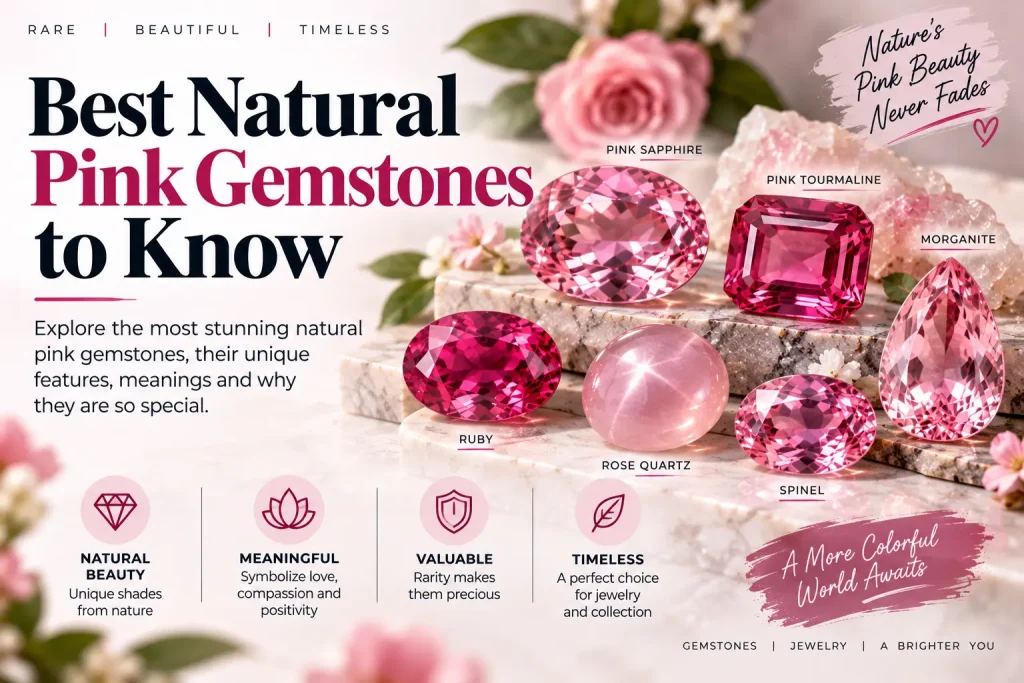
There is no single pink gemstone suitable for everyone. Pink sapphire and diamond offer excellent durability, while rose quartz provides an accessible decorative option. Morganite, tourmaline, spinel, and kunzite provide additional choices depending on your preferred shade, budget, and jewellery style.
1. Pink Sapphire
Pink sapphire is one of the most desirable natural pink gemstones for fine jewellery.
Sapphire belongs to the corundum mineral family and has a hardness of 9 on the Mohs scale. This makes pink sapphire highly resistant to scratching compared with most other coloured gemstones.
Its colours can range from pale pastel pink to intense pink and pinkish-red.
Pink sapphire is especially suitable for:
- Engagement rings
- Everyday rings
- Earrings
- Pendants
- Premium jewellery
Some natural sapphires are heat-treated to improve their colour or clarity. Treatment should therefore be disclosed when purchasing a valuable stone.
2. Morganite
Morganite is the pink to peach-pink variety of the mineral beryl, the same mineral family that includes emerald and aquamarine.
Its soft pastel appearance makes it particularly attractive in rose-gold jewellery. Morganite usually ranges from pale pink to peach, salmon, and slightly violet-pink tones.
With a Mohs hardness of approximately 7.5–8, it offers reasonable durability for jewellery, although care is still advisable.
Morganite is an excellent option for buyers who want an elegant pink stone with a softer appearance than vivid pink sapphire.
3. Rose Quartz
Rose quartz is one of the most recognizable pink gemstones.
It typically has a pale to medium pink appearance and can range from translucent to cloudy. Unlike premium transparent gems such as sapphire, rose quartz is often appreciated for its soft colour rather than exceptional brilliance.
Quartz has a Mohs hardness of 7.
Rose quartz is commonly used for:
- Pendants
- Beaded jewellery
- Decorative carvings
- Bracelets
- Cabochons
- Collectible pieces
It is generally more accessible than rare transparent pink gemstones, making it a practical choice for affordable jewellery.
4. Pink Tourmaline
Pink tourmaline offers one of the widest ranges of pink colours available in natural gemstones.
Depending on the specimen, it may appear pale pink, rose, raspberry, purplish pink, or strongly saturated reddish pink. Tourmaline has a Mohs hardness of approximately 7–7.5.
High-quality transparent stones with attractive saturation can be used in fine jewellery, while more affordable specimens are suitable for everyday fashion jewellery.
Pink tourmaline is especially worth considering when colour variety is a priority.
5. Pink Spinel
Natural pink spinel can offer bright colour and impressive brilliance.
Spinel occurs in several colours, including pink, red, purple, blue, and orange. Pink specimens can range from delicate pastel shades to highly saturated vivid pink.
With a Mohs hardness of 8, spinel is relatively durable and suitable for many types of jewellery.
High-quality natural pink spinel can be valuable, particularly when it combines strong colour, transparency, good cutting, and minimal treatment.
6. Kunzite
Kunzite is the pink to violet-pink variety of spodumene.
Its gentle lilac-pink and pastel shades can make it visually distinctive. Kunzite has a Mohs hardness of about 6.5–7, but hardness is not its only durability consideration. The stone has pronounced cleavage, meaning it requires thoughtful handling and setting.
Kunzite is often better suited to pendants, earrings, or jewellery worn with care rather than pieces exposed to frequent impacts.
Some kunzite can also experience colour changes after prolonged exposure to strong light, so sensible storage is recommended.
7. Pink Diamond
Natural pink diamonds are among the rarest and most prestigious pink gems.
Unlike common colourless diamonds, naturally pink diamonds obtain their colour primarily from structural changes within the crystal lattice rather than the trace elements responsible for colour in many other gemstones.
Diamond has a Mohs hardness of 10, the highest value on the scale.
Natural pink diamonds should not be confused with laboratory-grown pink diamonds or treated diamonds. Because significant value may be involved, an independent grading report from a respected gemological laboratory is particularly important.
Natural Pink Gemstones Comparison
The following comparison can help narrow down your choices.
| Gemstone | Typical Pink Appearance | Mohs Hardness | General Jewellery Suitability |
|---|---|---|---|
| Pink Diamond | Pale to intense pink | 10 | Excellent |
| Pink Sapphire | Light to vivid pink | 9 | Excellent |
| Pink Spinel | Pastel to vivid pink | 8 | Very good |
| Morganite | Pink to peach-pink | 7.5–8 | Good |
| Pink Tourmaline | Pale to deep pink | 7–7.5 | Good |
| Rose Quartz | Soft, cloudy rose-pink | 7 | Good with care |
| Kunzite | Pink to violet-pink | 6.5–7 | Better with careful wear |
Mohs hardness measures resistance to scratching. It does not measure every aspect of durability, so cleavage, toughness, setting style, and daily wear conditions should also be considered.
What Makes a Natural Pink Gemstone Valuable?
The value of a pink gemstone depends on several factors rather than colour alone.
Colour
Colour is often one of the most important considerations in coloured gemstones.
A desirable stone typically displays an attractive combination of hue, tone, and saturation. However, the preferred shade depends on the gemstone variety and individual taste.
A vivid pink sapphire, for example, cannot be valued using exactly the same standards as pale rose quartz.
Clarity
Clarity describes the presence or absence of internal and external features.
Some gemstones naturally contain more inclusions than others. A transparent gemstone with fewer distracting inclusions may command a premium, but clarity expectations should always be appropriate for that particular gem species.
Cut
Good cutting helps a gemstone interact attractively with light.
Poor proportions can make an otherwise beautiful stone look dark, dull, or lifeless. Symmetry, polish, proportions, and overall visual appeal should therefore be evaluated alongside colour.
Carat Weight
Larger fine-quality stones can become increasingly difficult to find.
However, carat weight alone does not determine value. A smaller gemstone with superior colour, clarity, rarity, and cutting can be more desirable than a larger low-quality example.
Origin and Rarity
Geographic origin can influence the market for certain important gemstones when that origin can be reliably established.
Rarity also matters. Natural pink diamonds, for instance, belong to a very different rarity category from commonly available rose quartz.
Treatments
Treatments may affect both appearance and value.
Heat treatment is accepted in parts of the coloured gemstone market, while other treatments can have different effects on durability, desirability, and price. Buyers should ask specifically whether a gemstone has been treated and request documentation for important purchases.
How to Identify Genuine Natural Pink Gemstones
You usually cannot confirm a valuable gemstone’s natural origin with certainty simply by looking at it.
Visual inspection may reveal warning signs, but proper identification can require gemological instruments and professional testing.
For an expensive purchase, follow these practical steps:
- Buy from a seller who clearly discloses whether the gemstone is natural, laboratory-grown, treated, or untreated.
- Request an invoice containing an accurate gemstone description.
- Ask whether any treatments have been applied.
- Request an independent laboratory report when the stone’s value justifies certification.
- Check that the report number and gemstone details match the stone being offered.
- Understand the seller’s return, exchange, and disclosure policies before paying.
A laboratory report is particularly useful when purchasing high-value sapphire, spinel, diamond, or other important coloured gemstones.
Natural vs Lab-Grown Pink Gemstones
A natural gemstone forms through geological processes, while a laboratory-grown gemstone is produced under controlled conditions designed to create material with essentially the same crystal structure and chemical properties as its natural counterpart.
This means a laboratory-grown gemstone is not necessarily the same thing as an imitation.
For example, a laboratory-grown diamond is diamond, whereas pink glass made to resemble a diamond is an imitation.
The important issue is disclosure.
Consumers should know exactly which category they are purchasing because natural rarity, availability, and market pricing can differ substantially from laboratory-grown material.
Best Pink Gemstone for Rings
Pink sapphire is one of the strongest choices for rings because its Mohs hardness of 9 provides excellent scratch resistance.
Pink spinel can also work well, while diamond provides exceptional hardness. Morganite and tourmaline are usable in rings but benefit from protective settings and sensible care.
Kunzite requires more caution because of its cleavage.
When choosing a ring, consider more than appearance. Think about how often you will wear it, your daily activities, the setting design, and how easily the gemstone can be cleaned or repaired.
Choosing Natural Pink Gemstones for Indian Jewellery
For buyers in India, pink gemstones can complement both contemporary and traditional jewellery designs.
Soft pink morganite can pair beautifully with rose gold, while brighter pink sapphire can create stronger contrast with yellow or white metal. Pink tourmaline and spinel can work well in colourful statement jewellery.
When choosing a stone, consider:
- Jewellery type
- Frequency of wear
- Metal colour
- Gemstone durability
- Preferred shade
- Certification
- Treatment disclosure
- Overall budget
For jewellery intended for regular use, durability should receive more attention than size alone.
Are Pink Gemstones Used in Astrology?
Certain gemstones have cultural and astrological associations in India, but such beliefs should be distinguished from gemological facts.
Gemology can scientifically examine properties such as mineral composition, hardness, refractive characteristics, inclusions, treatments, and origin indicators. Claims about gemstones changing luck, relationships, health, or future events are not established through standard gemological testing.
If you are buying primarily for jewellery, prioritize authenticity, quality, durability, and transparent seller information.
How to Care for Natural Pink Gemstones
Correct care depends on the specific gemstone.
There is no universal cleaning method that is ideal for every pink stone, particularly when treatments, inclusions, or fracture characteristics differ.
For general care:
- Store jewellery pieces separately to reduce scratching.
- Avoid unnecessary exposure to harsh household chemicals.
- Remove rings during activities that could cause impacts.
- Clean appropriate stones gently using mild soap, lukewarm water, and a soft brush.
- Avoid ultrasonic or steam cleaning unless you know it is safe for the specific gemstone and its treatments.
- Have valuable jewellery inspected periodically for loose stones or damaged settings.
Kunzite deserves additional protection from strong light and impacts.
Common Mistakes When Buying Pink Gemstones
One of the biggest mistakes is buying based only on a photograph.
Online images may look different because of lighting, camera processing, screen settings, or editing. Ask for videos or photographs under different lighting conditions when purchasing an expensive gemstone remotely.
Other common mistakes include:
- Assuming every natural gemstone is untreated
- Ignoring laboratory documentation for valuable stones
- Comparing prices without comparing quality
- Choosing size over colour and cut
- Confusing lab-grown gems with natural stones
- Treating hardness as the only measure of durability
- Failing to ask about return policies
- Buying solely because of unverified healing or investment claims
A transparent seller should be willing to explain what the stone is and what treatments are known.
How to Choose the Right Natural Pink Gemstone
Start by deciding how the jewellery will actually be worn.
For an everyday ring, pink sapphire, diamond, or spinel may be practical choices because of their durability. For an elegant pendant or occasional-wear piece, morganite, tourmaline, or kunzite can offer attractive alternatives.
Use this simple buying process:
- Decide your total budget.
- Choose the type of jewellery.
- Select your preferred pink shade.
- Compare gemstones with suitable durability.
- Review colour, clarity, cut, and carat weight.
- Ask about treatments.
- Obtain appropriate documentation for high-value purchases.
- Compare the complete quality of stones rather than carat size alone.
This approach helps you choose based on both beauty and practical suitability.
Frequently Asked Questions
Which natural pink gemstone is best for everyday jewellery?
Pink sapphire is particularly suitable for everyday jewellery because it has a Mohs hardness of 9 and good overall durability. Pink spinel is another practical option. The best choice still depends on the jewellery setting and how it will be worn, since even hard gemstones can be damaged by strong impacts or poor handling.
What is the rarest natural pink gemstone?
Natural pink diamonds are exceptionally rare, particularly specimens with strong natural colour and desirable quality characteristics. Rarity varies by size, colour intensity, clarity, and other factors. Buyers considering an expensive pink diamond should request an independent grading report confirming that the diamond and its colour are of natural origin.
Are natural pink gemstones expensive in India?
Prices vary enormously. Rose quartz can be relatively affordable, while fine pink sapphire, spinel, tourmaline, and especially natural pink diamond can command much higher prices. Instead of relying on a single price-per-carat estimate, compare the gemstone species, colour, clarity, cut, weight, treatment status, documentation, and seller reputation.
How can I know if a pink gemstone is natural?
Visual appearance alone cannot reliably establish natural origin for many valuable gemstones. Ask the seller for clear disclosure and, when appropriate, an independent gemological laboratory report. The report can help identify the gemstone and may provide information about natural or laboratory-grown origin and detectable treatments, depending on the stone and testing performed.
Which natural pink gemstone is suitable for a ring?
Pink sapphire, pink spinel, and pink diamond are strong candidates because they combine attractive colour with relatively high hardness. Morganite and pink tourmaline can also be used in rings when appropriately set and cared for. For frequent wear, consider overall toughness, cleavage, setting protection, and lifestyle rather than relying solely on Mohs hardness.
Conclusion
Natural pink gemstones offer an impressive range of colours, prices, rarity levels, and jewellery possibilities. Pink sapphire provides excellent durability, morganite offers gentle pastel shades, tourmaline delivers broad colour variety, spinel combines brilliance with good hardness, rose quartz offers accessible beauty, and pink diamond represents exceptional rarity.
The best gemstone is ultimately the one that matches your intended use, preferred shade, budget, and expectations for durability.
Before purchasing a valuable pink gemstone in India, compare stones in reliable lighting, ask about treatments and origin, review seller policies, and obtain independent gemological documentation when appropriate. Choosing carefully is far more important than simply buying the largest stone within your budget.