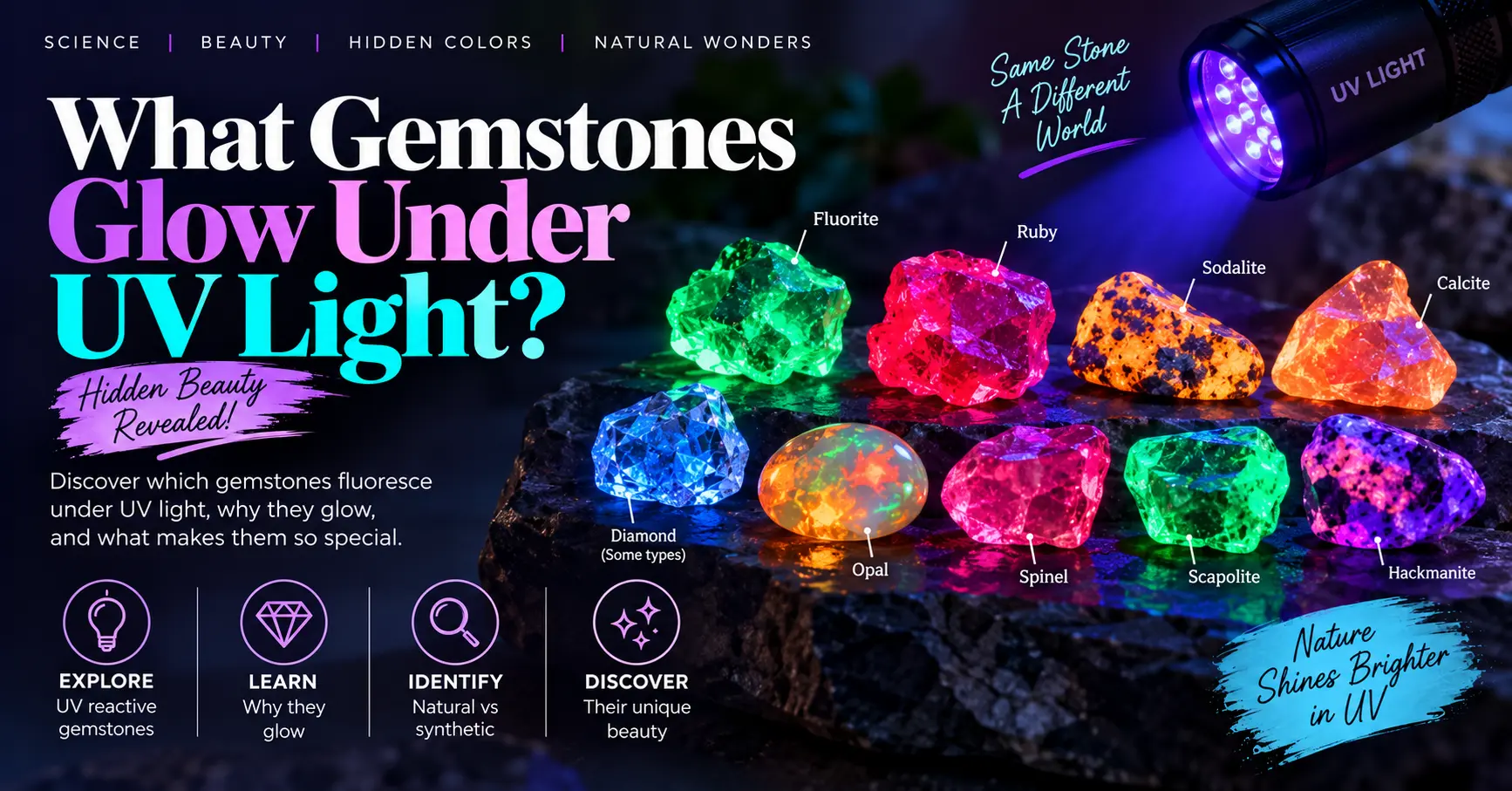

What gemstones glow under UV light? Many natural gemstones can produce visible fluorescence when exposed to ultraviolet (UV) light. Ruby may glow bright red, some diamonds can show blue fluorescence, certain fluorite specimens glow blue or violet, and some varieties of calcite, spinel, scapolite, and other gems may also fluoresce.
However, fluorescence is not guaranteed simply because a stone belongs to a particular gem species. The reaction depends on trace elements, structural defects, origin, treatments, and other characteristics of the individual specimen.
For gemstone buyers and collectors in India, a UV light can be an interesting supporting tool for examining jewellery and loose stones. It should not, however, replace professional gemological testing.
This guide explains which gemstones commonly fluoresce, what colors they may display, why fluorescence occurs, and how to examine gemstones under UV light safely and accurately.
What Does It Mean When a Gemstone Glows Under UV Light?
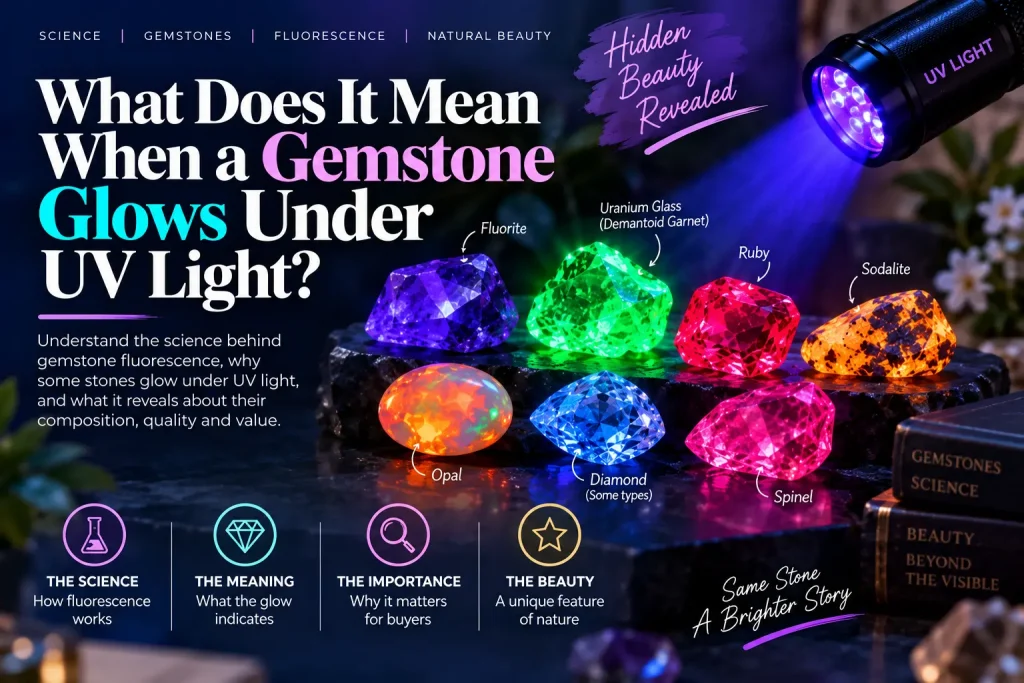
A gemstone that appears to glow under ultraviolet light is usually displaying fluorescence. Fluorescence occurs when certain components within the material absorb invisible ultraviolet radiation and quickly release part of that energy as visible light.
The visible glow normally disappears almost immediately after the UV source is switched off.
If the visible emission continues after the UV light has been removed, the phenomenon is called phosphorescence. Fluorescence and phosphorescence are both forms of luminescence, but they differ in how long the visible emission lasts.
Gemstone fluorescence can vary dramatically. A stone may show:
- Strong fluorescence
- Moderate fluorescence
- Weak fluorescence
- No visible fluorescence
Even two gemstones of the same variety can behave differently under identical UV conditions.
What Gemstones Glow Under UV Light?
Some of the best-known fluorescent gem materials include ruby, diamond, fluorite, calcite, spinel, scapolite, and certain other minerals. Their exact response varies from one specimen to another.
Here is a useful comparison:
| Gemstone or Mineral | Possible UV Reaction | Common Fluorescence Color |
|---|---|---|
| Ruby | Often strong | Red to bright red |
| Diamond | Variable | Commonly blue when fluorescent |
| Fluorite | Often fluorescent in suitable specimens | Blue, violet, or other colors |
| Calcite | Highly variable | Red, orange, pink, blue, or other colors |
| Spinel | Variable | Red, orange-red, or other responses |
| Scapolite | Variable | Yellow, orange, pink, or other colors |
| Sapphire | Usually variable or weak | Depends strongly on composition |
| Opal | Variable | Greenish, white, or other reactions in some material |
These colors are general possibilities rather than identification rules. Origin, chemical composition, treatments, impurities, and the wavelength of the UV lamp can change the observed result.
Why Do Some Gemstones Glow Under UV Light?
Gemstones glow because ultraviolet energy interacts with particular elements or defects within their crystal structures.
These fluorescence-producing components are often called activators. Chromium, manganese, rare-earth elements, structural defects, and other factors can influence luminescence depending on the mineral.
The process can be understood simply:
- UV radiation reaches the gemstone.
- Certain components in the stone absorb that energy.
- Electrons temporarily move into higher-energy states.
- The electrons return toward their normal state.
- Some of the absorbed energy is released as visible light.
This visible emission is the glow you see.
Not every gemstone contains the right activators, and some elements can suppress fluorescence. That is one reason specimens of the same mineral may respond differently.
Ruby: One of the Most Recognizable UV-Reactive Gemstones
Ruby is famous for its potentially intense red fluorescence. The effect is primarily associated with chromium, the element also responsible for ruby’s red coloration.
Under suitable UV illumination, some rubies can appear strikingly bright red.
Does Every Ruby Glow?
No. The strength of fluorescence varies considerably.
Iron content can reduce the fluorescence associated with chromium. As a result, rubies from different geological environments may show different reactions.
A strong red UV response can therefore provide useful information, but it cannot independently prove that a stone is a natural ruby or determine its geographic origin.
Synthetic rubies can also fluoresce strongly.
Do Diamonds Glow Under UV Light?
Yes, some diamonds fluoresce under UV light, although others show little or no fluorescence.
Blue is a particularly well-known fluorescence color in diamonds. Other fluorescence colors can occur, but they are less typical.
Diamond fluorescence is related to atomic-scale characteristics and defects within the crystal.
Does Fluorescence Mean a Diamond Is Fake?
No. Fluorescence is found in natural diamonds and is not, by itself, evidence that a diamond is synthetic or an imitation.
Likewise, the absence of fluorescence does not prove anything about authenticity.
Diamond identification requires examination of multiple characteristics rather than relying on a single UV response.
Fluorite and Its Famous Fluorescence
Fluorite has a particularly strong historical association with fluorescence. In fact, the scientific term fluorescence was derived from the mineral fluorite.
Many fluorite specimens display blue or violet fluorescence, although different colors and intensities are possible depending on impurities and crystal chemistry.
Fluorite is relatively soft compared with many popular jewellery gemstones. Therefore, even an attractive fluorescent fluorite specimen needs careful handling if used in jewellery.
Calcite Under UV Light
Calcite is another mineral known for remarkably varied fluorescence.
Depending on its composition and locality, calcite may display red, orange, pink, blue, cream, or other visible responses under UV illumination.
Manganese is an important activator in many fluorescent calcite specimens, although the chemistry of luminescence can involve additional factors.
Because calcite fluorescence varies so widely, UV examination is particularly interesting for mineral collectors.
Does Spinel Glow Under UV Light?
Some spinel can fluoresce, especially chromium-bearing red or pink material.
A red or orange-red reaction may occur in certain specimens. Other spinels may react weakly or show no obvious fluorescence.
This makes UV testing potentially useful as part of a broader gemological examination, particularly when comparing visually similar red gemstones.
However, fluorescence alone should never be used to distinguish spinel conclusively from ruby or other red stones.
Can Sapphire Glow Under UV Light?
Some sapphires fluoresce, while many show weak fluorescence or none that is obvious to the eye.
The reaction depends strongly on trace-element chemistry and the individual stone. Iron can suppress fluorescence in corundum, which helps explain why some sapphires show little response.
Colorless, pink, yellow, and other sapphire varieties can also behave differently.
A UV lamp therefore provides supporting evidence rather than a universal sapphire test.
Other Gemstones and Minerals That May Fluoresce
Beyond the best-known examples, fluorescence can occur in numerous gem and mineral materials.
Scapolite
Certain scapolite specimens can display attractive yellow, orange, pink, or related fluorescence. The response depends on composition and origin.
Opal
Some opals may show greenish, white, or other fluorescence. Certain specimens can also display persistent luminescence after the UV source is removed.
Because opal includes different types and formation environments, reactions vary considerably.
Amber
Some amber can fluoresce under ultraviolet illumination, often displaying blue, greenish, yellowish, or other tones depending on the material.
UV examination is sometimes used when studying amber, but fluorescence alone cannot reliably establish authenticity.
Long-Wave vs Short-Wave UV Light
An important part of understanding what gemstones glow under UV light is recognizing that not all UV lamps produce the same response.
Gemological examination traditionally distinguishes between long-wave and short-wave ultraviolet radiation.
Long-Wave UV
Long-wave UV is commonly associated with wavelengths around 365 nm in gemological and mineral examination.
Many readily available UV flashlights operate near this wavelength.
Short-Wave UV
Short-wave UV is commonly associated with approximately 254 nm.
A gemstone may react strongly to one wavelength and weakly—or not visibly at all—to another. Therefore, UV wavelength should always be considered when recording fluorescence observations.
Short-wave UV also requires greater safety precautions because it presents more significant risks to eyes and skin.
How to Check a Gemstone With UV Light
A controlled environment makes fluorescence easier to observe and reduces misleading reflections.
A simple examination can be performed as follows:
- Clean the gemstone. Dirt, oils, coatings, and residues can affect what you see.
- Darken the room. Ambient light makes weak fluorescence difficult to observe.
- Place the gemstone on a neutral surface. A non-fluorescent dark background is useful.
- Illuminate it with an appropriate UV lamp. Follow the lamp manufacturer’s safety instructions.
- Observe the color and intensity. Record whether fluorescence appears weak, moderate, or strong.
- Switch the UV source off. Check whether any visible glow continues briefly.
- Compare observations carefully. Treat the result as one piece of evidence, not a final identification.
Never stare directly into a UV lamp or deliberately expose your eyes or skin to UV radiation. Short-wave UV sources require particularly careful shielding and handling.
Can UV Light Identify a Real Gemstone?
UV fluorescence can support gemstone identification, but it generally cannot identify a gemstone conclusively on its own.
Several natural, synthetic, treated, and imitation materials can produce similar fluorescence.
For example, strong red fluorescence might be consistent with ruby, but synthetic ruby can produce a similar response. Likewise, a non-fluorescent stone is not automatically fake.
Professional gemologists may combine fluorescence observations with:
- Refractive index
- Specific gravity
- Microscopic examination
- Spectroscopy
- Inclusion analysis
- Pleochroism
- Optical properties
- Advanced laboratory testing when required
The combination of evidence produces a much more reliable identification.
Can UV Light Reveal Gemstone Treatments?
Sometimes UV examination can reveal unusual patterns or reactions that encourage further investigation, but it is not a universal treatment detector.
Treatments such as filling, coating, heating, irradiation, or diffusion may affect gemstones in different ways. Some treated materials can display fluorescence patterns that are useful to trained gemologists, while others cannot be reliably assessed using UV alone.
If treatment status affects a gemstone’s price or purchase decision, request a report from a reputable gemological laboratory.
Natural vs Synthetic Gemstones Under UV Light
UV fluorescence alone cannot reliably separate every natural gemstone from its laboratory-grown counterpart.
Synthetic gems are designed to reproduce the basic chemical and physical characteristics of natural materials. They can therefore exhibit fluorescence that resembles natural stones.
Synthetic ruby is a classic example. Some laboratory-grown rubies can fluoresce extremely strongly because of their chromium content and relatively low concentration of fluorescence-quenching elements such as iron.
Gemologists examine growth structures, inclusions, spectroscopy, fluorescence patterns, and other properties before reaching an identification.
Why Does the Same Gemstone Show Different Fluorescence?
Variation is normal because gemstones are natural or manufactured materials with different chemical compositions and structural characteristics.
Two rubies, diamonds, or fluorites may look similar in ordinary light but react differently under UV.
Important factors include:
- Trace-element concentration
- Crystal defects
- Geological formation conditions
- Synthetic growth method
- Treatments
- Fluorescence-quenching elements
- UV wavelength
- Strength of the UV source
- Viewing conditions
This variability is exactly why fluorescence should be treated as supporting evidence.
UV Gemstone Testing for Buyers in India
India has a major jewellery and gemstone market, so buyers may encounter everything from precious gemstones to synthetic stones, treated material, and inexpensive imitations.
A small UV lamp can be useful for collectors who want to observe fluorescence, but it should not replace proper certification when purchasing a valuable gemstone.
For higher-value diamonds, rubies, sapphires, emeralds, or other gems, ask the seller for an independent laboratory report when appropriate.
The report can provide considerably more meaningful information about identification and, depending on the laboratory and stone, treatments or origin.
Common Mistakes When Testing Gemstones With UV Light
The most common mistake is treating fluorescence as proof of identity.
Other problems include testing in a bright room, confusing reflected violet light with actual fluorescence, failing to identify the lamp wavelength, or assuming every specimen of one gem variety should react identically.
Another mistake is comparing stones photographed under different cameras and lighting conditions. Smartphone cameras can alter saturation, brightness, and color balance, making fluorescence appear different from what the eye sees.
For consistent results, use the same UV source, viewing environment, background, and observation method.
Benefits and Limitations of UV Gemstone Testing
UV examination is popular because it is fast, visually interesting, and non-destructive when suitable equipment is used correctly.
It can help collectors observe luminescence, compare specimens, notice unusual reactions, and gather additional clues during identification.
Its biggest limitation is specificity.
Many different materials can produce similar fluorescence, while individual specimens of the same gemstone can produce different reactions. A UV test therefore works best as one component of a broader gemological examination.
Frequently Asked Questions
1. What gemstones glow under UV light the most?
Ruby is one of the most recognizable gemstones for strong red fluorescence, while fluorite and some calcite specimens can also produce striking reactions. Certain diamonds, spinels, scapolites, opals, and other materials may fluoresce as well. Intensity varies between specimens, so gemstone type alone cannot predict exactly how strongly a stone will glow.
2. What gemstone glows red under UV light?
Ruby is particularly well known for red fluorescence because chromium can act as a fluorescence activator. Some red spinels and other minerals may also produce reddish fluorescence. Therefore, seeing a red glow is not enough to identify an unknown stone as ruby without additional gemological tests.
3. Do real diamonds glow under UV light?
Some natural diamonds fluoresce and some do not. Blue is a common fluorescence color among diamonds that show a visible reaction, although other colors are possible. Fluorescence is not proof that a diamond is genuine, synthetic, valuable, or low quality. It is simply one characteristic that can be recorded during examination.
4. Can a UV flashlight tell if a gemstone is fake?
Not reliably. A UV flashlight can provide useful clues, but natural gems, synthetic gems, treated stones, and imitations may sometimes produce similar reactions. Reliable identification requires additional properties such as refractive index, inclusions, spectroscopy, or professional laboratory testing.
5. Why doesn’t my gemstone glow under UV light?
A gemstone may contain too little of the necessary fluorescence activators, contain elements that suppress fluorescence, or respond better to a different UV wavelength. Some specimens simply do not fluoresce visibly. Lack of fluorescence does not automatically mean a gemstone is fake or incorrectly identified.
Conclusion
Understanding what gemstones glow under UV light can make gemstone examination more informative and interesting. Ruby is famous for red fluorescence, some diamonds display blue fluorescence, and minerals such as fluorite, calcite, spinel, scapolite, opal, and amber can also show distinctive UV reactions.
The most important point is that fluorescence varies from specimen to specimen. UV response can provide valuable clues, but it should never be treated as definitive proof of gemstone identity, natural origin, treatment status, or value.
If you are examining gemstones at home, start with a suitable long-wave UV lamp, work in a dark environment, follow proper eye and skin safety precautions, and record each stone’s reaction. For valuable purchases, use UV observations alongside professional gemological testing and a reliable laboratory report.