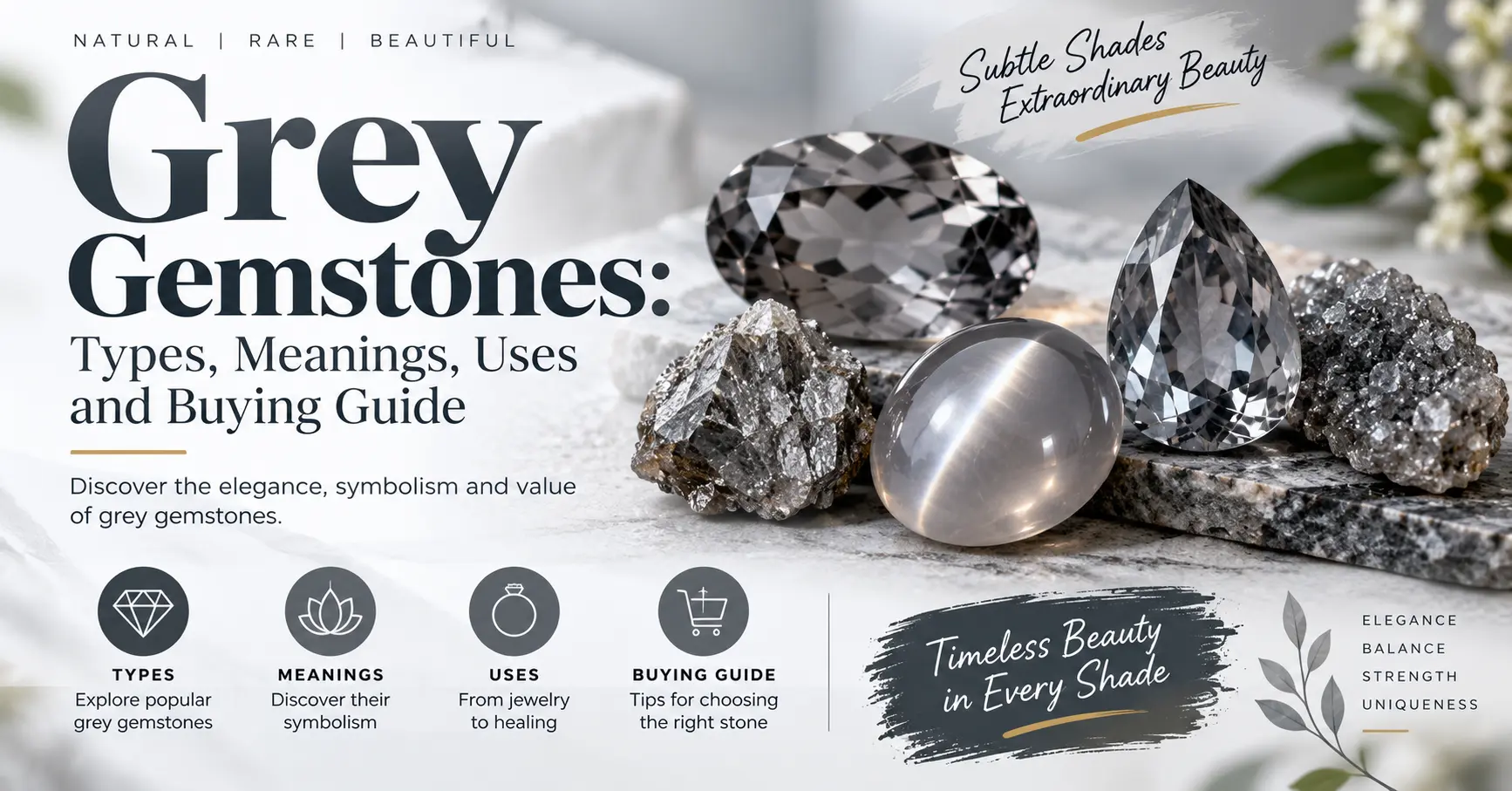

Grey gemstones offer a sophisticated alternative to traditional brightly coloured stones. From shimmering grey moonstone and metallic hematite to smoky quartz and elegant grey diamonds, these stones appear in many shades, textures, levels of transparency, and price ranges.
For buyers in India, grey stones can be especially interesting for rings, pendants, bracelets, earrings, beads, and custom jewellery. Some varieties are valued mainly for their beauty, while others also have cultural, spiritual, or astrological associations.
This guide explains the most popular grey gemstones, their characteristics, jewellery uses, meanings, advantages, limitations, identification tips, care requirements, and important points to consider before buying one.
What Are Grey Gemstones?
Grey gemstones are natural or, in some cases, laboratory-created gem materials whose dominant visible colour ranges from pale silver-grey to charcoal, smoky grey, or almost black.
Their colour can result from the stone’s mineral composition, inclusions, crystal structure, trace elements, or other natural geological processes. The appearance varies significantly between gem varieties.
Some grey stones are transparent or translucent, while others are completely opaque. Their surface appearance may range from glassy and brilliant to metallic or softly glowing.
Popular examples include:
- Grey moonstone
- Grey diamond
- Hematite
- Smoky quartz
- Grey spinel
- Grey sapphire
- Labradorite
- Grey chalcedony
- Tahitian-type grey pearls
Not every stone marketed as grey has exactly the same characteristics, so buyers should evaluate the specific gemstone rather than choosing based on colour alone.
Why Are Grey Gemstones Popular?
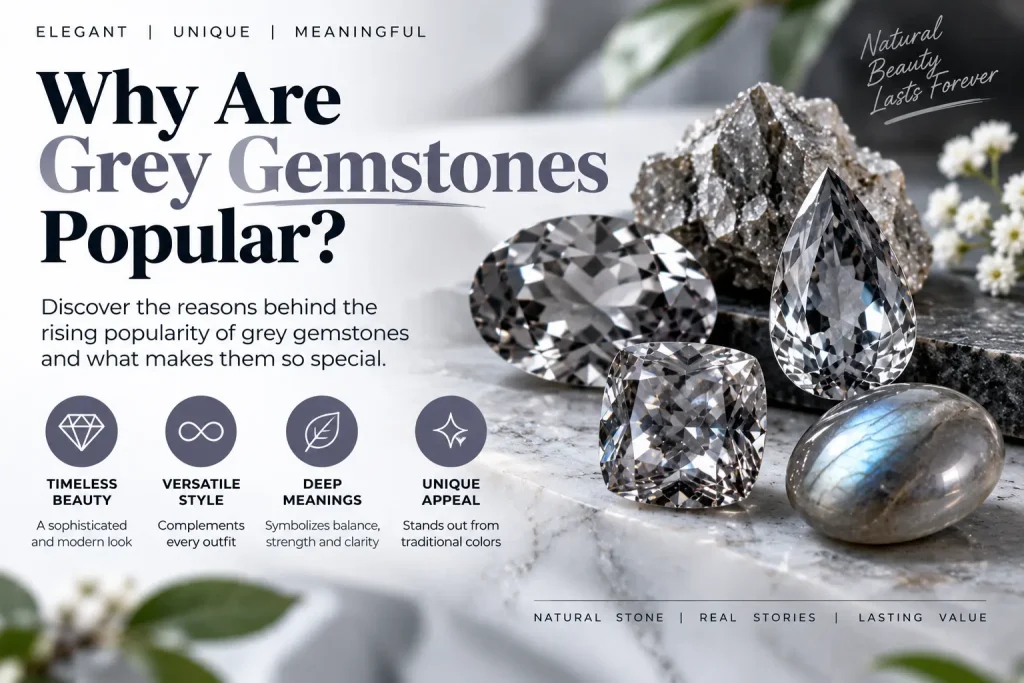
Grey gemstones are popular because their neutral colour works well with many jewellery styles and metal colours. They can look minimalist, luxurious, modern, mysterious, or vintage depending on the gemstone and setting.
Unlike strongly coloured gems, grey stones generally do not dominate an entire jewellery design. This makes them particularly useful when the goal is understated elegance.
Versatile Colour
Grey pairs naturally with white gold, silver, platinum, yellow gold, and rose gold.
A pale silver-grey stone can create a clean contemporary appearance, while charcoal-grey gems provide stronger contrast.
Distinctive Appearance
Certain grey gems display visual effects beyond their base colour.
Moonstone can show a floating glow known as adularescence. Labradorite may display flashes of blue, green, gold, or other colours through labradorescence. Hematite, meanwhile, is known for its metallic appearance.
These optical characteristics can make two apparently similar grey stones look dramatically different.
Suitable for Different Jewellery Styles
Grey stones can complement minimalist jewellery as well as elaborate traditional designs. They may be used as centre stones, accent stones, beads, cabochons, or decorative elements.
The best choice depends on the gem’s durability and the type of jewellery being made.
Popular Types of Grey Gemstones
Several gemstone families contain attractive grey varieties. Understanding their basic characteristics makes choosing the right one easier.
| Gemstone | Typical Appearance | Mohs Hardness | Common Jewellery Use |
|---|---|---|---|
| Grey Diamond | Grey, silver-grey, brilliant | 10 | Rings, earrings, pendants |
| Grey Sapphire | Light to dark grey | 9 | Rings, pendants, earrings |
| Grey Spinel | Silver to charcoal grey | 8 | Rings, earrings |
| Smoky Quartz | Smoky grey to brown-grey | 7 | Pendants, rings, beads |
| Grey Chalcedony | Soft translucent grey | 6.5–7 | Pendants, beads |
| Moonstone | Grey with floating sheen | 6–6.5 | Pendants, earrings, rings |
| Labradorite | Grey with colourful flashes | 6–6.5 | Pendants, earrings |
| Hematite | Dark grey, metallic | 5–6 | Beads, bracelets, pendants |
Mohs hardness measures resistance to scratching, not resistance to breaking or chipping. Jewellery durability therefore depends on more than hardness alone.
Grey Moonstone
Grey moonstone is recognised for its soft grey body colour and distinctive floating light effect.
That optical phenomenon is called adularescence. It can produce an attractive glow that appears to move across the gemstone as the viewing angle changes.
Moonstone is commonly cut into cabochons because a smooth domed surface can display this effect effectively.
Best Uses
Grey moonstone works especially well in:
- Pendants
- Earrings
- Necklaces
- Occasional-wear rings
Because moonstone is softer than sapphire, spinel, or diamond, protective settings are useful when it is worn in rings.
Grey Diamond
Grey diamonds combine the exceptional hardness associated with diamond with an unusual neutral colour.
Their appearance can range from pale silvery grey to deeper charcoal tones. Some may contain visible inclusions that contribute to their distinctive character.
Diamond ranks 10 on the Mohs scale, making it highly resistant to scratching. However, diamonds can still chip under a sufficiently hard impact, particularly around vulnerable edges.
Grey diamonds may suit buyers looking for a durable centre stone with a less conventional appearance than a colourless diamond.
Grey Sapphire
Grey sapphire offers excellent durability and a subtle colour palette.
Sapphire belongs to the corundum mineral family and has a Mohs hardness of 9. This makes it suitable for jewellery that may receive regular wear.
Grey sapphires can vary from relatively light silver tones to much darker shades. Colour distribution, transparency, cut quality, treatments, and inclusions can all influence appearance and value.
For buyers seeking a durable grey stone for a ring, sapphire is worth considering.
Grey Spinel
Grey spinel is increasingly appreciated for its attractive neutral shades and good durability.
It has a Mohs hardness of 8, making it suitable for many types of jewellery. Fine examples can display an appealing combination of brilliance and steel-grey, silver-grey, or darker tones.
Spinel may be a useful option for someone who wants a naturally elegant grey gemstone without automatically choosing diamond or sapphire.
Smoky Quartz
Smoky quartz ranges from light smoky tones to deep brownish-grey.
With a Mohs hardness of 7, quartz has reasonable scratch resistance for many jewellery applications. It is widely used in rings, pendants, necklaces, and larger statement pieces.
One advantage of smoky quartz is that relatively large stones can often be found, making it suitable for bold jewellery designs.
Buyers should remember that its colour commonly leans toward brown rather than being purely neutral grey.
Labradorite
Labradorite is famous for colourful flashes appearing over a grey or dark body colour.
This optical effect is known as labradorescence. Depending on the specimen and viewing angle, flashes may appear blue, green, yellow, orange, or in other colours.
Because this visual effect is strongly affected by orientation, skilled cutting is particularly important.
Labradorite is excellent for decorative jewellery, especially pendants and earrings. Rings require more careful wear because the material is not as hard as sapphire or spinel.
Hematite
Hematite has a distinctive dark metallic-grey appearance.
Unlike transparent faceted gems, polished hematite commonly produces a smooth, reflective metallic surface. It is frequently used for beads, bracelets, pendants, and men’s jewellery.
Hematite requires sensible handling because its durability characteristics differ from harder transparent gemstones.
Its strong metallic appearance makes it particularly suitable for contemporary and minimalist designs.
Grey Chalcedony
Grey chalcedony has a smooth, subdued appearance and is often translucent.
It belongs to the quartz family and is commonly fashioned into cabochons, beads, carvings, and decorative jewellery.
Rather than intense sparkle, chalcedony is valued for its soft colour and attractive surface appearance. This makes it useful for jewellery designs where subtlety is more important than brilliance.
What Do Grey Gemstones Mean?
The meaning of grey gemstones depends heavily on cultural tradition, personal belief, and the individual stone.
Grey as a colour is commonly associated in design and symbolism with neutrality, balance, sophistication, and calmness. Individual gemstones may have additional meanings attributed to them in different spiritual traditions.
For example, moonstone has long been associated in various traditions with the Moon, while hematite and smoky quartz are sometimes marketed in crystal practices as grounding stones.
These associations should be understood as traditional or spiritual beliefs rather than scientifically established medical effects.
Grey Gemstones in Indian Jewellery
In India, gemstone jewellery can be selected for fashion, gifting, religious tradition, personal preference, or astrology.
Grey stones can work particularly well in contemporary Indian jewellery because their understated colour pairs easily with both Western and traditional clothing.
For example, a grey gemstone pendant can complement everyday clothing, while grey sapphire, spinel, or diamond can create an elegant centre stone for a premium ring.
When purchasing a gemstone specifically for Jyotish or astrological purposes, appearance alone is not enough. Gem identity, treatment status, quality, and the specific astrological tradition being followed may matter. Buyers should seek appropriate qualified guidance rather than assuming every grey stone has the same astrological significance.
How to Choose the Best Grey Gemstone
The best grey gemstone depends on how you intend to wear it, your preferred appearance, and your budget.
1. Decide How the Stone Will Be Worn
Start with the jewellery type.
A ring receives considerably more daily contact than a pendant or earrings. For frequent-wear rings, harder options such as diamond, sapphire, and spinel generally deserve consideration.
More delicate materials may be better suited to protected settings or jewellery worn occasionally.
2. Examine the Colour
Grey is not a single shade.
Compare stones under neutral lighting and look for:
- Silver-grey
- Steel-grey
- Charcoal
- Blue-grey
- Smoky grey
- Brown-grey
- Nearly black tones
Choose according to personal preference rather than assuming darker or lighter automatically means better quality.
3. Check Transparency and Inclusions
Transparency varies naturally by gem species.
Visible inclusions are not automatically a defect. In some gemstones, they contribute to character, while in others they may influence transparency, durability, or market value.
What matters is whether the stone matches the quality represented by the seller.
4. Evaluate the Cut
A good cut should complement the gemstone.
Transparent stones are often faceted to improve brilliance, whereas moonstone and chalcedony frequently look better as cabochons.
Labradorite must also be oriented carefully to show its strongest colour effect.
5. Ask About Treatments
Do not assume a gemstone is untreated.
Ask the seller whether the stone has undergone heating, irradiation, dyeing, coating, filling, or another treatment. The relevant treatments differ by gemstone species.
Treatment disclosure is important because it can affect value, care requirements, and purchasing decisions.
6. Request Reliable Documentation for Valuable Stones
For higher-value purchases, particularly diamonds, sapphires, and other premium gems, consider obtaining a report from a reputable independent gemological laboratory.
A laboratory report can provide information about gemstone identity and, depending on the report and stone, treatments or other characteristics.
Natural vs Synthetic Grey Gemstones
Natural gemstones form through geological processes, whereas synthetic gemstones are produced in laboratories but can have essentially the same crystal structure and chemical composition as their natural counterparts.
A synthetic gemstone is different from an imitation.
An imitation may simply resemble another gemstone visually without sharing its composition.
Buyers should therefore look for accurate descriptions such as:
- Natural
- Laboratory-grown or synthetic
- Treated
- Imitation or simulant
Clear disclosure helps buyers understand exactly what they are purchasing.
Benefits of Choosing Grey Gemstones
The main advantages of grey gemstones come from their visual versatility and wide variety.
Depending on the specific stone, benefits can include:
- Neutral colours that match many outfits
- Options for minimalist and statement jewellery
- Compatibility with different precious metals
- Choices across different budgets
- Transparent, translucent, and opaque varieties
- Interesting optical effects in moonstone and labradorite
- Durable choices such as diamond, sapphire, and spinel
The variety means buyers can choose according to appearance and practical requirements rather than colour alone.
Limitations to Consider
Grey gemstones also have limitations that vary considerably between species.
Softer gems can scratch more easily than harder ones. Some stones can chip if struck, and certain materials require more careful cleaning.
Colour can also vary substantially between online photographs and real-world viewing because lighting, camera processing, screen settings, and gemstone orientation influence appearance.
Another common issue is unclear identification. Similar-looking grey stones may have very different compositions and values, so reliable seller disclosure becomes increasingly important for expensive purchases.
How to Care for Grey Gemstone Jewellery
The safest cleaning method depends on the gemstone.
For many pieces, gentle cleaning with lukewarm water, mild soap, and a soft cloth or brush may be appropriate. However, not every gemstone should be treated identically.
Avoid assuming that ultrasonic or steam cleaning is safe for every grey stone. Fractures, inclusions, treatments, and gemstone type can affect whether these cleaning methods are suitable.
Store jewellery pieces separately to reduce scratching and accidental contact.
For valuable jewellery, follow care recommendations appropriate to the identified gemstone and any disclosed treatment.
Common Mistakes When Buying Grey Gemstones
A few avoidable mistakes can lead to disappointing purchases.
Buying only by colour: Two grey stones can have completely different durability, rarity, and value.
Ignoring treatments: Treatment status can influence both price and care.
Choosing a soft stone for an exposed everyday ring: Jewellery use should match gemstone durability.
Assuming spiritual benefits are medical facts: Traditional gemstone beliefs should not replace medical advice or evidence-based healthcare.
Skipping documentation on expensive purchases: Independent identification can be valuable when significant money is involved.
Relying entirely on edited photos: Whenever possible, examine clear photographs or videos under different lighting conditions.
Frequently Asked Questions
1. What are the most popular grey gemstones?
Popular grey gemstones include grey diamond, grey sapphire, grey spinel, grey moonstone, smoky quartz, labradorite, hematite, and grey chalcedony. Each has different colour, hardness, transparency, optical effects, and price characteristics. The best option depends on whether you prioritise durability, brilliance, unusual visual effects, affordability, or a particular jewellery style.
2. Which grey gemstone is best for everyday rings?
Diamond, sapphire, and spinel are among the stronger candidates for frequent-wear rings because they offer relatively high scratch resistance. Diamond ranks 10, sapphire 9, and spinel 8 on the Mohs scale. Hardness is not the only durability factor, however, so setting design, gemstone condition, and careful wear remain important.
3. Are grey gemstones expensive?
Prices vary enormously. Grey gemstone is a colour category rather than a single material, so an affordable quartz or chalcedony cannot be priced using the same standards as a fine diamond or sapphire. Size, origin, natural versus synthetic status, treatments, clarity, colour, cut, rarity, and seller documentation can all affect the final price.
4. Are grey gemstones suitable for Indian jewellery?
Yes. Grey stones can be used in rings, earrings, necklaces, bracelets, and both modern and traditional-inspired jewellery. Their neutral appearance pairs with yellow gold, rose gold, silver-toned metals, and many clothing colours. If a stone is being purchased specifically for Indian astrology, obtain appropriate guidance about the required gemstone rather than selecting solely by colour.
5. How can I tell whether a grey gemstone is genuine?
Visual inspection alone may not reliably identify many gemstones. Start by checking the seller’s disclosure, return policy, treatment information, and product description. For valuable purchases, an independent gemological laboratory report provides stronger evidence of identity. Be cautious when expensive stones are offered with extraordinary claims, unclear documentation, or prices that appear inconsistent with the stated material.
Conclusion
Grey gemstones combine neutral colour with an impressive range of appearances, from the metallic shine of hematite and the floating glow of moonstone to the colourful flashes of labradorite and durability of sapphire, spinel, and diamond.
There is no single grey stone that suits every buyer. The right choice depends on jewellery type, durability requirements, colour preference, treatment status, authenticity, and budget.
Before purchasing, identify the exact gemstone, compare its practical characteristics, ask about treatments, and choose a reputable seller. For expensive stones, consider independent gemological documentation. This approach helps you select a grey gemstone that is both visually appealing and appropriate for how you plan to wear it.